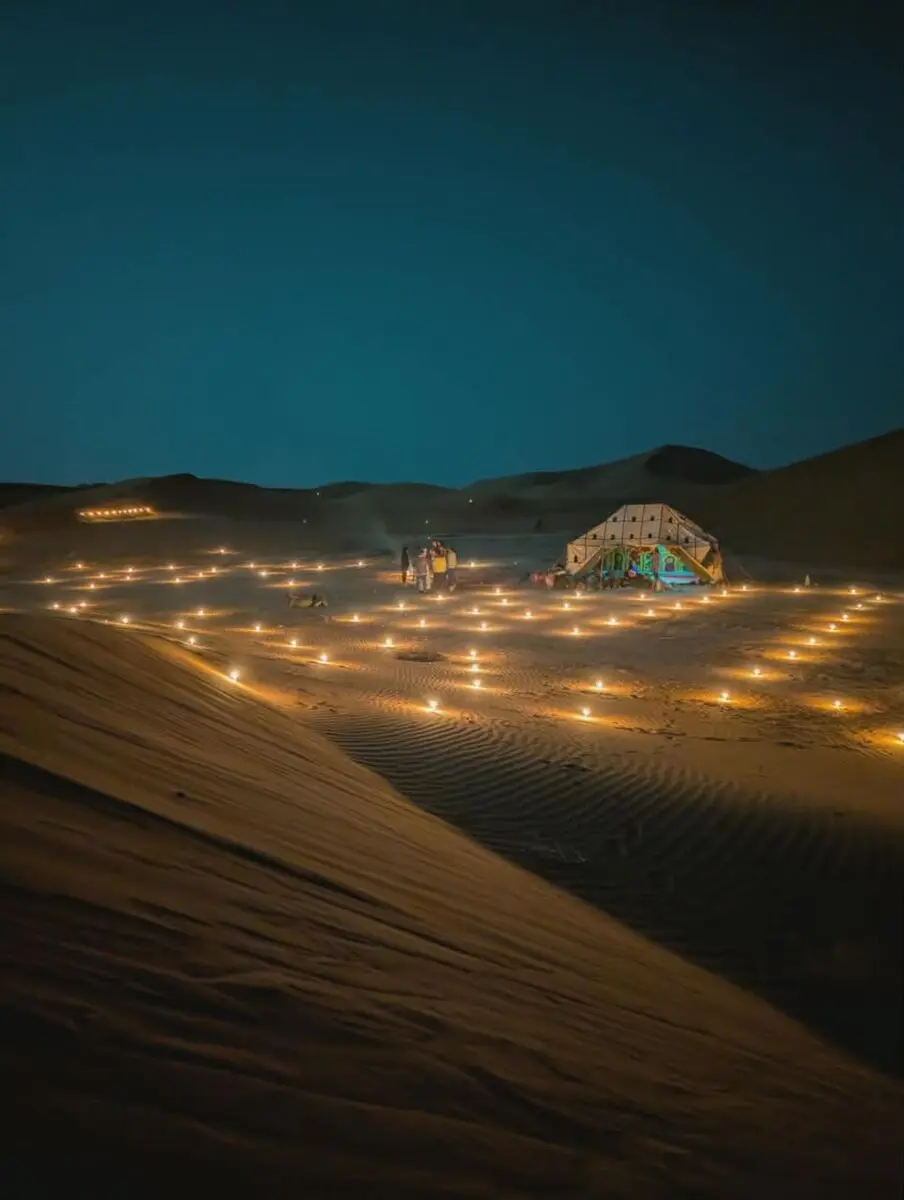
At midnight, the camp has stopped explaining itself.
The last plates have been cleared. A conversation has broken into shorter phrases, then into silence. Someone closes a tent. A vehicle that was audible earlier has gone beyond the range of attention, or stopped altogether. The fire has changed from an activity into a low source of heat and light. Most people are asleep.
At first, the night seems soundless.
Then the ear begins to separate what the city normally covers. A fabric edge moves. Sand strikes the side of a tent in a brief, dry scatter. Someone crosses the ground and the footsteps arrive as distinct events rather than part of a continuous background. Wind gathers on one side of the camp and loosens on the other. An animal shifts. Far away, there may be another human sound, or there may not.
This is not a promise that every night at M’Hamid will sound the same. Wind, weather, camp location, nearby roads, guests, animals and lighting all change the experience. The point is more modest and more interesting: the Sahara is not silent. It is a place where fewer sounds compete for attention.
M’Hamid El Ghizlane is a good place to notice the change. The town and its oasis have their own evening life. Beyond them, desert camps sit within a wider acoustic space. Moving from one to the other is not only a change in scenery. It is a transition from a soundscape with many human sources to one where small sounds can occupy the foreground.
Midnight
A traveler sitting outside a tent at M’Hamid may begin by hearing the remains of the evening rather than the desert itself.
There may be cooking, conversation, the movement of chairs, water being poured, dishes being handled, a door or tent flap, and the practical sounds of people preparing for sleep. A camp may use vehicles, pumps, refrigeration, solar equipment or a generator, depending on its design and location. Another camp may be close enough for voices or music to carry. Some evenings include organised entertainment; others do not. A desert camp is not automatically a naturally silent place.
As activity thins out, the listener’s sense of distance changes. A sound that would disappear in a town may remain identifiable for longer. A footstep seems important because it is not mixed with traffic. A short conversation may feel close even when the speaker is not. This is partly an experience of contrast. The ear has fewer continuous mechanical sounds against which to measure everything else.
The night also changes in stages rather than switching off at a particular hour. Sunset brings movement. Dinner brings concentration and conversation. Later, people separate into tents or small groups. Around midnight, there may be longer intervals between events. Before dawn, the pattern begins to change again. This is an editorial way of listening, not a universal timetable. Different camps and different nights produce different sequences.
Silence is not the absence of sound
The word silence can be misleading. In ordinary speech, it may mean that nothing is audible. In a desert camp, it more often means the absence of a dense, continuous background.
Traffic is not passing every few seconds. Building systems are not enclosing the listener. Air-conditioning units, street lighting, delivery vehicles and neighbouring rooms are less likely to form a constant layer. The sounds that remain may be softer, farther apart or more dependent on weather.
Soundscape research often separates the acoustic environment into three broad components: geophony, the sounds of weather and the Earth; biophony, sounds made by animals; and anthrophony, human-generated sound, including machines. The categories overlap in lived experience, but they are useful here. A midnight camp may include wind as geophony, an insect or animal as biophony, and a closing tent or distant vehicle as anthrophony. The Sahara is not empty of any of these. Their balance changes.
Open country does not make every sound travel perfectly. Wind can mask small sounds and create its own noise. Temperature, humidity, land cover and topography influence how sound travels. The U.S. National Park Service notes that wind speed, land cover, elevation, temperature and humidity all matter when monitoring natural sound environments. In M’Hamid, a calm night and a windy night can therefore feel like two different places. On one evening, a distant sound may be noticeable. On another, blowing sand and moving air may occupy nearly all of the available attention.
Nor does sand absorb all sound. That popular image is too simple. Surfaces, wind, terrain and distance all affect what reaches the ear. Dunes may interrupt or redirect a sound; an open flat area may allow it to remain perceptible farther away. The correct description is not that sound disappears, but that the acoustic conditions change.
The desert has its own soundtrack
Wind is usually the most obvious variable. It may arrive as a steady flow, a series of stronger passages, or a restless movement that seems to change direction around tents and low walls. It can lift fine sand, move fabric, disturb loose objects and make the camp’s edges audible. When the wind rises, it may cover quieter sounds entirely. When it falls, those sounds return without having been created anew.
Sand itself is less a single sound than a set of possibilities. It can tap against cloth, slide under a foot, scrape beneath a vehicle or move across a hard surface. The sound depends on grain, speed, moisture, wind and what the sand meets. A traveler may hear the result without being able to identify its source immediately.
Footsteps become part of the geography. Near a camp, they may tell you that someone is moving between tents. Farther out, the same action can seem strangely isolated. The ground changes the rhythm: firm earth, gravel, packed paths and loose dune sand do not return the same sound. The ear begins to notice the surface through the body’s movement.
Domestic animals may also be audible, depending on the camp and season. A camel may shift, breathe, vocalise or move its load. A dog, donkey or other animal may respond to activity. These sounds should not be expected on every night, and they should not be staged for visitors. Animals are part of local work and travel, not props in a desert performance.
Insects and other nocturnal life may contribute small sounds when conditions allow. A researcher or guide may distinguish more than a visitor can. The safer statement is that nighttime biological activity can be present, but its audibility varies with temperature, wind, habitat, season and distance. The Sahara does not offer a wildlife checklist on demand.
The Draa Valley adds another layer. M’Hamid is not only dunes. It is also an oasis environment with palms, cultivated areas, villages and human activity. Near the oasis, the night may include sounds associated with settlement, agriculture, animals and movement. Farther from buildings, those sources may become less frequent, but the transition is gradual rather than absolute.
From firelight to quiet
The human soundscape deserves as much attention as the wind.
At a desert camp, people prepare the night. Tea may involve the handling of metal, glass, water and heat. Cooking produces movement, conversation and the practical sounds of serving. A tent gathers and softens voices, while an open circle around a fire allows them to travel. Someone may laugh. Someone may speak on a phone. A guide may explain the next day’s route. A vehicle may arrive late or leave early.
Music is possible in M’Hamid and in desert tourism, but it should not be treated as a guaranteed or timeless soundtrack. The Draa-Tafilalet region has living musical traditions and contemporary cultural programmes, while camps may also offer performances designed for guests. These are not automatically the same thing. A visitor should ask what they are hearing rather than turn an evening performance into proof of an unchanged ancient custom.
The heritage work documented in M’Hamid also reminds us that cultural life happens through people and labour. A 2017 study of the oasis describes restoration and cultural workshops involving local craftsmen and international participants. The important lesson for a soundscape article is not that a particular traditional sound can be assigned to every village. It is that M’Hamid is a lived community with work, social exchange, architecture and cultural choices. A campfire is a human meeting place before it is an atmospheric image.
Later, the sounds of the camp become less continuous. A spoon is placed down. A tent zip closes. A low voice travels a short distance and ends. Someone walks across the sand and disappears into darkness. These moments may stay in memory because they are not spectacular. Their scale is small enough for attention to rest on them.
What the wind changes
Wind can transform the night faster than a clock.
When it is light, a traveler may notice separate events: a footstep, a fabric movement, a distant animal, a short exchange between people. When it strengthens, the soundscape becomes broader and less divisible. Sand brushes against surfaces. Tent walls move. Loose material rattles. Voices require more effort. The wind becomes not just one sound but the condition through which all other sounds must be heard.
Weather also changes what a camp feels like acoustically. A clear, still night may make distance seem open. Dust or haze may alter the impression of the horizon and the clarity of faraway sources. Temperature and humidity influence sound propagation, although a visitor does not need technical instruments to notice that some nights carry sound differently from others.
This is one reason not to promise a particular Sahara experience. A remote camp is not an acoustic recording played on demand. It is a place subject to weather, location, people and practical activity. The most honest description is conditional: you may hear wind, sand, animals, insects, voices or vehicles, depending on the night.
The same honesty applies to the idea of “natural silence.” A generator can be useful. A vehicle can be necessary. A phone can be important for safety. A camp’s lights and machinery are part of modern desert tourism, not evidence that the experience has failed. The question is how these sounds are managed and whether visitors understand that local people and other guests are entitled to rest.
Listening to a landscape
In cities, sound often arrives as a continuous layer. The listener learns to ignore traffic, ventilation, distant construction and the activity of other people. Quiet can initially feel strange because attention has been calibrated to a busier background.
In M’Hamid, the reduction of continuous noise can make individual events more noticeable. This is an editorial interpretation supported by a basic acoustic fact: when fewer sounds mask one another, the remaining sounds are easier to distinguish. Soundscape studies also show that acoustic patterns vary across time and space, and that the sonic geography of a place does not always match its visual geography. A landscape that looks uniform may sound different near a road, a palm grove, a settlement, a dune field or a camp.
The listener begins to map the night by interruption. There is wind, then no wind. There is a voice, then its absence. A footstep approaches and recedes. A vehicle becomes a diminishing mechanical tone. An animal makes one sound and then is hidden again by distance. Quiet is not a blank interval between important events. It is what gives the events their shape.
The open desert also changes the relationship between direction and sound. A source may be difficult to locate because there are few visual references at night. A sound can seem close, then farther away when the listener turns. The ear needs time to learn the geography. A local guide may understand the significance of a sound that a visitor treats as mysterious: a vehicle on a track, activity at another camp, or a change in wind coming across open ground.
This is why listening is a form of local learning. The aim is not to romanticise the desert as a speaking presence. It is to recognise that a place offers information through more than its view.
The sounds we bring with us
Travelers do not arrive acoustically empty.
They bring the remembered traffic of cities, the expectation of entertainment, the reflex to fill pauses with music, and the habit of checking a phone whenever nothing appears to be happening. A desert night can expose those habits because the surroundings do not immediately replace them.
A responsible listener does not demand absolute silence from a camp. People need to talk, cook, work, move and use technology. A quiet experience should not depend on treating camp workers as invisible or asking a community to perform remoteness for guests. It is enough to let the night become quieter when activity is finished.
Lower the music rather than assuming the dunes will absorb it. Avoid unnecessary engine use. Respect sleeping guests and nearby camps. Do not disturb animals or follow a sound into a private area. Ask before recording people, conversations or performances. A sound recording can preserve an atmosphere, but it can also capture someone who did not agree to become part of it.
For Desert Lotus Retreat’s travelers, the most meaningful change may be simple: wait. Do not judge the night by the first ten minutes after dinner. The camp is still settling. Let the human sounds recede at their own pace. Then listen again.
When the desert goes quiet
At midnight, M’Hamid is not a blank space and the desert is not a mute one. The oasis remains nearby. A camp still contains people. Roads, vehicles, phones, animals and distant settlements continue to exist. Wind may rise. A tent may move. An insect may be active beyond the circle of light. Or the night may offer almost nothing distinct for several minutes.
That last possibility is not a failure. It is the experience.
Quiet makes the listener aware of distance, but also of attention. It reveals how much sound a city supplies before anyone asks for it. It makes a small movement feel precise. It turns the end of a conversation into an event. It gives the wind room to become weather rather than background.
A traveler may remember the desert by its stars, but the memory may return through the ear: the last cup set down, the change in the tent fabric, the footstep that crossed the sand, the engine fading toward the road, the wind arriving after everyone stopped speaking.
The Sahara does not need to be silent to be quiet. It only needs fewer voices competing at once.
🐪 Sleep under the quiet desert sky on a short camel trek. short-treks.html → · private-trips.html →