Rain reaches the desert as an apparent contradiction. Water touches sand, stone and the hard edge of an oasis, and a landscape associated with dryness begins to change. Yet the important story starts before the first green shoot. Rain does not create life from nothing. It alters the conditions under which life that was already present can become more visible, more active or more mobile.
Around M’Hamid El Ghizlane, at the southern end of Morocco’s Draa Valley, that distinction matters. M’Hamid is an oasis settlement connected to cultivated land, groundwater, irrigation, roads, desert tracks and wider open surfaces. The surrounding Sahara is not one uniform ecosystem. A sandy erg, a stony hamada, a shallow depression, an oasis garden and a compacted track may all receive the same storm and respond differently.
So what happens after the rain stops? Some water infiltrates. Some runs across the surface. Some is taken up by plants. Some evaporates quickly. In a depression, a temporary pool may remain; on a sealed or steep surface, water may become runoff. A pulse of moisture can alter soil organisms, seed germination, plant cover and the movement of insects. It can also leave almost no visible trace if the rain is light, localized or followed by intense heat.
The desert after rain is therefore not a simple transformation from dead to alive. It is a short negotiation between water, soil, temperature, biology and time.
The Desert Was Never Lifeless
The word “desert” often encourages a visual mistake. Bare ground is mistaken for empty ground. A surface without a green canopy is treated as though no ecological process is taking place. In reality, arid landscapes contain organisms and relationships adapted to scarcity: plants that limit water loss, seeds that remain dormant, soil microbes, insects, reptiles, birds, mammals and people whose activities are connected to water and seasonal conditions.
Their strategies differ. Some perennial plants reduce growth during dry periods and resume activity when moisture returns. Some annual plants invest in seeds that can remain inactive until a combination of moisture and temperature makes germination possible. Biological soil crusts, where present, can bind or stabilize the upper soil surface and contribute to dryland processes. Not every adaptation occurs in every desert, and no single mechanism should be used as a universal explanation for the Sahara.
A useful ecological concept is the precipitation pulse. In arid-land research, rain events can act as short-lived inputs that stimulate biological activity until the available moisture is depleted. The USGS describes this as part of a “pulse-reserve” framework: rainfall drives activity, while ecosystems retain reserves that help them persist between pulses.
This language is more accurate than saying the desert suddenly comes alive. The life was there, although it may have been dormant, concealed, metabolically reduced or simply difficult to see. Rain changes the visibility and timing of its activity.
What the First Rain Actually Does
The first drops do not behave identically on every surface around M’Hamid. Soil texture, slope, crusting, vegetation, stone cover and the intensity of the storm all affect what happens next. Loose sand may accept water differently from compacted ground. A shallow depression can collect water while a nearby ridge dries almost immediately.
Some rainfall infiltrates into the upper soil. That moisture may be available to roots and microorganisms, depending on depth and evaporation. Some water flows laterally, carrying fine particles and reshaping small channels. Heavy rain can generate runoff and erosion. In suitable terrain, it can contribute to temporary streams or flash flooding, especially where water comes from a larger catchment rather than falling only at the point where it is observed. A light shower does not imply a flood, and a dry-looking sky above a track does not guarantee that a distant wadi is safe.
The balance is governed by heat and air movement. In a hot arid environment, surface water can disappear quickly through evaporation. This is why a storm can leave a strong short-term signal without replenishing groundwater or transforming the whole landscape. Groundwater is stored below the surface and recharged through particular pathways; a single rain can benefit a shallow surface layer without directly supplying the aquifer used by an oasis.
The first ecological response may be invisible. Soil microbes can respond to moisture before a traveller notices a plant. Seeds may absorb water but fail to germinate if the pulse is too brief, the temperature unsuitable or the seed already non-viable. A longer or repeated sequence of rains can produce a different result from one isolated shower. The amount, timing and distribution of water matter as much as the fact that rain occurred.
Seeds That Wait
One of the desert’s most compelling adaptations is not dramatic growth but restraint. Many annual plants in drylands survive unfavourable periods as seeds. Dormancy prevents germination when a brief wetting would be followed by lethal dryness. A seed that germinated after every small shower could spend its limited reserves on a plant with no time to reproduce.
When enough moisture arrives, and when temperature and other cues are suitable, some seeds can germinate rapidly. The result may be a temporary flush of grasses or annual herbs in particular patches rather than a uniform green carpet. Germination is often spatially uneven because rainfall itself is uneven and because soil stores water differently from one micro-site to the next.
This is why the phrase “desert bloom” needs care. Flowering can occur in some deserts after favourable rain, but it is not an automatic sequel to every storm, and it is not a reliable promise for every visitor to M’Hamid. The response may be green rather than floral, subtle rather than spectacular, or limited to depressions and oasis margins. It may also be delayed. Plants need time to germinate, establish leaves and draw on the moisture before it is lost.
Around M’Hamid, the clearest distinction is between vegetation associated with the oasis and temporary growth on surrounding desert surfaces. A palm grove is part of a managed agricultural system. A short-lived patch of annual plants after rain is a pulse response to a particular combination of rainfall, soil and season. They should not be described as the same phenomenon.
When the Oasis Meets the Rain
M’Hamid’s oasis is not simply a place where rainfall falls and crops immediately drink it. Oasis agriculture depends on a relationship among surface water, groundwater, irrigation infrastructure, soils, crops and human management. Research on the Middle Draa Valley models M’Hamid as the southernmost oasis in a connected water system and distinguishes water demand, aquifer storage, reservoir releases and irrigation efficiency.
That distinction helps explain why a rainstorm can be important without being sufficient. Rain may wet cultivated soil, reduce immediate irrigation demand or produce runoff that affects a particular field. But oasis agriculture cannot be understood as rain-fed in the same way as a seasonal grassland. Water applied through irrigation, water held in the aquifer and water moving through the Draa system have different pathways and timescales.
The oasis also demonstrates that arid landscapes are shaped by both ecology and management. Date palms and lower crops occupy a layered agricultural environment in which shade, soil and irrigation influence what can grow. The surrounding desert and the cultivated oasis are connected, but they are not interchangeable. One responds to a rain pulse through temporary moisture and germination; the other is maintained through a longer system of water allocation and care.
Studies of M’Hamid have documented changes in oasis vegetation cover associated with irregular rainfall, drought, sand encroachment and other environmental and social pressures. One study using satellite imagery and field information reported a 22 percent loss of oasis area over the study period it examined. Such findings should not be used to create a dramatic before-and-after story for one storm. They do, however, make the oasis context impossible to ignore. Rain is part of a larger water story, not a substitute for one.
Animals Notice the Change
Animals may respond to rain indirectly, through the resources it changes. If a rain pulse produces plant growth, it can alter food and shelter for herbivorous insects. Those insects can then affect predators and other consumers. A six-year study in an arid savannah found that seasonal rainfall and plant cover helped explain arthropod community composition. Plant cover responded soon after rainfall, followed by herbivorous and predatory arthropods, while some omnivorous groups showed a longer lag.
This is useful as a general desert-ecology example, not as a promise of a particular spectacle around M’Hamid. A traveller may notice more tracks, insects or bird activity after favourable weather, but the species present and the timing will depend on local habitat, temperature, rainfall amount and the interval since the storm. A heavy downpour can also disturb or kill small organisms rather than benefit them. Rain is a resource pulse, not a universal advantage.
The most accurate way to look for life after rain is to look for relationships rather than a parade of animals. A plant patch may attract insects. Insects may attract birds. Damp soil may change the activity of small invertebrates. A shallow pool, where one forms, may be used briefly by organisms adapted to temporary water. These processes can be real without being visible on demand.
The same caution applies to amphibians, reptiles and mammals. Some desert animals respond to rainfall through breeding, feeding or movement, but such responses are species-specific and geographically variable. There is no scientifically responsible basis for promising that animals will appear everywhere immediately after a storm.
A Different Desert to the Human Eye
Rain changes the surface before it changes the horizon. Sand may darken. Fine sediment can settle into a shallow depression. Small rills may mark a slope. Stones may appear sharper against wet ground. The air may become cooler for a time, and visibility may improve or worsen depending on dust, cloud and humidity.
The smell can change too, but it should not be exaggerated. What people call petrichor is a mixture of compounds released or made more noticeable when rain wets dry surfaces, including compounds associated with soil microorganisms and plant oils. The intensity depends on the surface, the amount of rain and the air. Some desert showers produce a distinct earthy scent; others pass with little noticeable fragrance.
Sound changes with the ground. Drops striking canvas, stone or sand do not sound the same. Runoff can briefly animate a channel. Wind may follow a storm, carrying cooler air or dust. After the rain, the quiet is not necessarily deeper, but the acoustic character can be different because the surface, temperature and camp activity have changed.
For a traveller near M’Hamid, the most valuable observation may be a comparison. Look at the same ridge before and after a shower if possible. Notice which surfaces hold colour and which lose it quickly. Watch for a change in tracks, crusts, puddle edges or plant patches without stepping on them. The desert after rain is often a study in small differences.
Rain Is Never the Same in the Sahara
The Sahara is vast, and “Sahara rainfall” is not one condition. Rainfall varies across distance, season and elevation. It also varies from year to year, and individual storms may be sharply localized. Two places a short drive apart can receive different amounts. One depression may collect water while an adjacent dune remains dry.
The M’Hamid oasis study links local ecological change to irregular rains and successive drought years. Research on the wider Draa Valley also identifies drought and desertification as connected pressures shaped by natural and human factors. These findings support caution, not a simple slogan about a region becoming uniformly drier every year. Natural variability, long-term trends, water management and land use interact.
The response of the landscape depends on more than rainfall totals. The timing of rain determines whether temperatures are suitable for germination. The interval between storms determines whether seedlings survive. Soil texture controls infiltration and storage. Heat controls evaporation. Wind can move loose sediment. Grazing and cultivation change the surface. A small amount of well-timed rain may matter more to a particular plant community than a larger but badly timed event.
This variability is one reason a fixed “Sahara experience” does not exist. M’Hamid in a dry spell, M’Hamid after a localized shower and M’Hamid during a cooler season can offer different visual and practical conditions while remaining the same place.
What Rain Means for People Around M’Hamid
Rain is ecological, but it is also practical. It can affect the condition of tracks, the ease of movement and the timing of a desert journey. Wet surfaces may be slippery or soft. Runoff from elsewhere may reach a low-lying route after the sky overhead has cleared. A guide may change an itinerary not because the landscape has become dangerous everywhere, but because a specific crossing, depression or track is temporarily unsuitable.
For agriculture, rain can reduce stress on cultivated soil or alter when irrigation is needed, but it does not remove the need for water management. For grazing, a later increase in vegetation may matter more than the immediate shower. For households and operators, weather can affect transport, camp setup and daily work. These effects are not identical for every resident, farmer or guide, and they should not be turned into a single romantic story about people waiting for rain.
Visitors can help by treating weather as information rather than interruption. Ask the local guide about the route. Do not enter a wadi or low depression simply because it appears dry. Avoid driving across sensitive wet ground if doing so would damage the surface. Respect cultivated land and palm groves. Keep away from animals and do not pick plants after a rare flush of growth. Leave no waste, and allow the landscape to recover without turning a temporary change into a souvenir.
Learning to Look at the Desert Differently
The most important transformation after rain may occur in the observer. A dry surface no longer looks like a failed version of a green one. It becomes a record of thresholds: where water stopped, where it infiltrated, where it ran, where a seed waited and where heat reclaimed the surface.
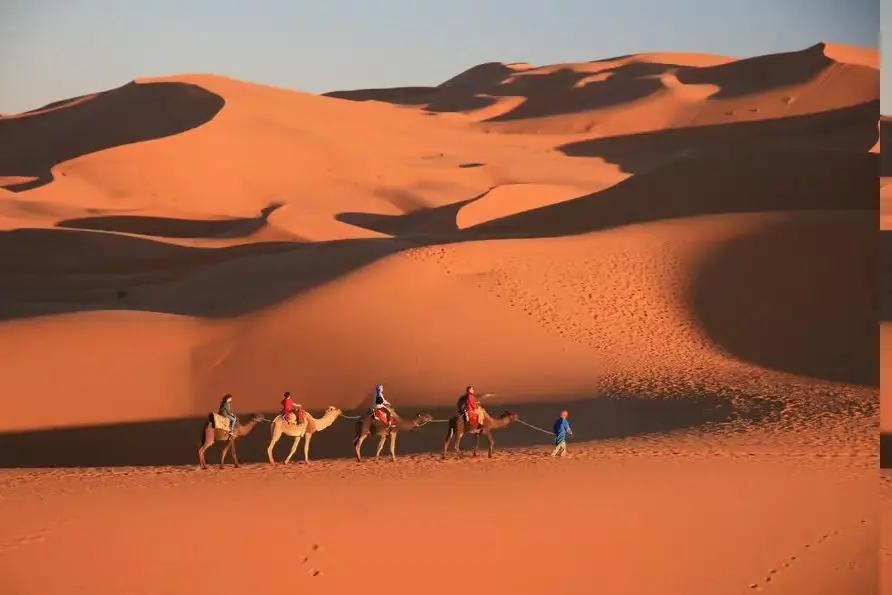
M’Hamid makes these thresholds visible because oasis and open desert meet within one lived region. The palm grove, the cultivated plot, the track, the stone plain and the dunes are not interchangeable, but they are connected by water, movement and human decisions. Rain reveals some of those connections without explaining all of them.
The desert is not waiting to become something else. It is already an ecosystem adapted to scarcity. Its biology is often quiet because water is limited, not because life is absent. A rain pulse can make that life easier to see, but the pulse is brief, uneven and conditional.
The Desert Between Rains
After the surface dries, the evidence may remain in a darkened line of soil, a new track, a softened crust, a germinating seed or a patch of green that lasts only as long as the moisture allows. The landscape does not return to a single normal. It carries the memory of water in different ways and for different lengths of time.
Around M’Hamid El Ghizlane, rain is therefore neither a miracle nor a simple interruption of drought. It is one event in a system that includes the oasis, groundwater, irrigation, sand, soil, plants, insects, animals, farmers, guides and travellers. Its effects may be visible within hours, delayed for weeks or absent to the casual eye.
To watch the desert after rain is to learn that scarcity does not mean stillness. It means that every response is measured. Water arrives, and the living landscape answers according to what it has stored, what it can absorb and how long the opportunity lasts.
🐪 See how rain changes the desert on a 4x4 excursion or travel guide. 4x4-excursions.html → · travel-guide.html →