A line of dunes catches the late light. The foreground is clean, the sky is wide, and a figure crosses the frame with the deliberate pace that makes a desert image feel complete. The camera rises almost by instinct.
Then comes the question that a beautiful photograph can conceal: what happens when the most interesting part of the picture is a person?
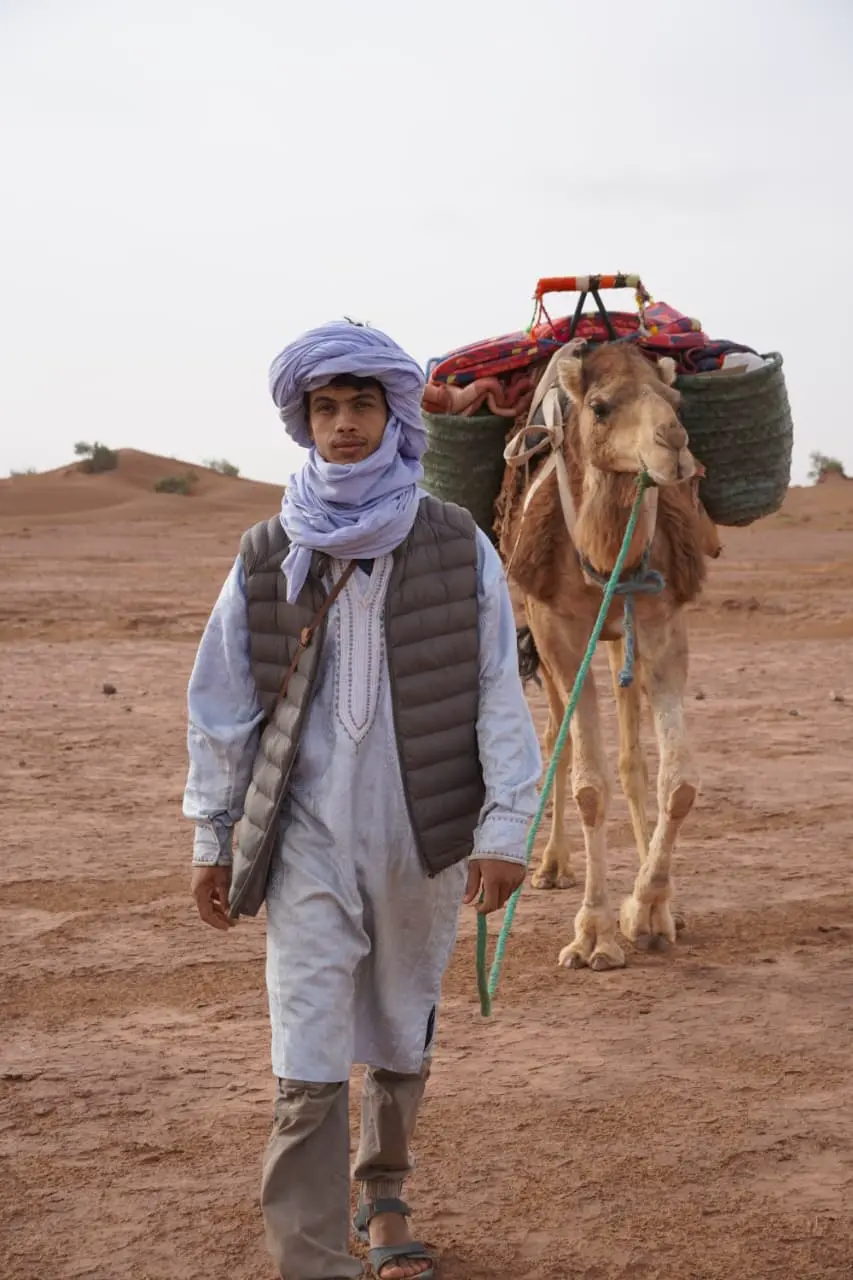
The figure may be a guide, a driver, a camp worker, a farmer, a musician, a traveller or a resident of M’Hamid El Ghizlane. They may have entered the frame as part of an ordinary day, or because a photographer asked them to pause. They may understand that a picture is being made, but not where it will appear, who will see it, or what story a caption will attach to their face.
This is why desert photography is never only about dunes. Every image of M’Hamid exists within a human landscape: an oasis sustained by water and labour, a settlement with its own everyday life, routes shaped by work and tourism, and relationships between visitors and the people who help them move through the Sahara.
The answer is not to put the camera away. It is to use it with more awareness. A photograph can be visually striking while still allowing the people and places within it to remain more than scenery.
A Camera Changes the Relationship
A camera is not a transparent window. It changes a situation simply by arriving in it. A person may become more self-conscious, more performative or more cautious. A worker may feel obliged to smile for a guest. A child may be curious about the device without understanding the reach of social media. A guide may agree to a portrait because the relationship includes hospitality, paid work or an unequal distribution of power.
Professional visual-ethics codes describe this responsibility in different ways. World Press Photo asks photographers to consider their influence on a scene, handle consent appropriately, treat people with dignity, avoid stereotypes and provide accurate captions . The National Press Photographers Association emphasises accurate and comprehensive representation, context, respect, restraint and editing that does not mislead . These standards were developed for visual journalism and documentary work, not as a universal lawbook for holiday photography. Their value for a visitor is practical: before pressing the shutter, notice that the photograph is a relationship as well as a file.
Who is looking? Who is being looked at? Who controls the image after the journey? What context will remain if the photograph is separated from the place where it was made?
In M’Hamid, these questions may arise in a palm grove, beside a vehicle, at a camp, on a route toward Erg Zahar or during an evening when music and conversation bring people together. The setting can change, but the responsibility remains.
People Are Not Part of the Scenery
A travel photograph often contains people even when it appears to be about landscape. A guide gives scale to a dune. A cook is caught beside a fire. A farmer appears between palms. A driver waits beside a 4x4. A child walks through a village street. A musician becomes part of the atmosphere of a camp.
Each person has a life that extends beyond the image. They have reasons for being where they are, relationships the visitor cannot see, and a right to decide how much of themselves becomes part of someone else’s story. The fact that a person makes an image more vivid does not make them available as a visual resource.
This does not mean that every background figure requires a formal production process. Context matters. A wide photograph of a public scene, a close portrait, a documentary project, a commercial campaign and a private travel album carry different expectations. The ethical question is not whether one rule can cover every situation. It is whether the photographer has noticed the person’s presence and exercised judgment rather than treating visibility as permission.
A portrait can celebrate someone’s work and character without turning them into a decorative symbol. It can show a guide as a professional rather than as an emblem of an imagined desert past. It can show a farmer in an oasis without implying that local life is primitive or frozen in time. It can include a camp worker without making service labour disappear behind the romance of the evening.
Ask Before You Photograph
For a close portrait, ask first. Make the request clear through words, gesture or the help of a guide who can translate. A smile, a pause or the absence of an objection is not necessarily explicit consent. If the person declines, move on immediately. Do not take the same person repeatedly because their face, clothing or manner seems visually striking.
When appropriate, explain what you are doing and where the image may be used. “This is for my private album” is different from “I may publish this on a public account” or “This is for a commercial website.” People cannot make an informed choice about an image whose possible use has been hidden from them.
Norms vary between communities, families, settings and individuals. There is no single photography rule that applies identically to every Moroccan community or every situation in M’Hamid. A respectful conversation is safer than a confident assumption. A local guide can help with language and context, but a guide’s presence does not replace the subject’s own willingness.
Be particularly considerate with workers. Someone preparing food, loading a vehicle or managing animals may be busy rather than available for a portrait. A guest’s payment for an excursion does not automatically include the right to turn every worker into content. Ask, wait for a suitable moment and accept that the answer may be no.
Children Need More Care
Children deserve particular caution because they may be curious, eager to please or unable to understand the future circulation of an image. Do not photograph unfamiliar children for social-media content simply because they appear spontaneous or photogenic.
UNICEF’s ethical reporting guidance places children’s dignity, privacy, participation and protection from harm at the centre of visual representation. It recommends permission from both the child and a parent or guardian for documentary photographs when possible, and asks photographers to explain the purpose and possible dissemination of the image . This is ethical guidance for reporting, not a claim about Moroccan law. Legal requirements vary by jurisdiction and context and should not be guessed.
For a traveller, the practical standard is clear. Ask the child in an age-appropriate way, involve a parent or responsible adult, do not stage an action the child would not otherwise perform, and do not publish an image that could expose, embarrass or endanger them. When permission is uncertain, photograph the wider scene without making a child the subject, or put the camera away.
When “Exotic” Becomes a Problem
The word “exotic” can seem harmless when applied to a landscape. It becomes more troubling when it turns people into evidence of difference. Repeated images of mysterious faces, traditional clothing treated as costume, poverty framed as visual drama, or everyday work presented as something strange can create a simplified picture of a community even when the photographer means no harm.
M’Hamid is not a blank stage for a traveller’s imagination. It is an oasis settlement and a base for contemporary work, tourism, agriculture and movement. The broader Draa Valley also has a documented history of irrigated agriculture, settlement and caravan connections, but historical depth is not a reason to describe present-day residents as “lost in time” . A caption that says “a local man in the Sahara” may be factually thin and emotionally loaded. A caption that explains the person’s role, with information confirmed rather than invented, can return some context to the image.
The problem is not beauty. The problem is what beauty removes. A dramatic portrait can still reinforce a stereotype if the viewer is encouraged to see a person only as mysterious, timeless or picturesque. The photographer’s task is not to make every image sociological. It is to notice when a visual choice narrows a person into a type.
Photographing M’Hamid Beyond the Dunes
M’Hamid is often photographed through its most recognisable forms: sand, sunset, camel and sky. Those images have their place, but they are not the whole destination.
The region includes the settlement itself, the oasis, date palms, cultivated areas, roads, tracks, stone and sandy plains, camps, changing light and the night sky. The wider landscape is visually diverse because it is geographically and socially diverse. A photograph of the oasis can make viewers curious about water and irrigation. A road can show the infrastructure that connects the town to the desert. A camp can reveal preparation and work rather than only firelight. A quiet frame after sunset can communicate temperature, distance and darkness without promising a particular astronomical display.
The oasis is especially important. Research focused on M’Hamid found significant changes in vegetation cover between 1984 and 2016, in a context that included aridity, water scarcity, sand movement and socio-economic pressures . Research on the Middle Drâa describes M’Hamid as the last oasis in the water-system sequence studied and identifies agriculture as the dominant component of demand in the modelled valley . A photograph cannot explain those systems by itself, but it can either invite questions or hide them.
Photographing a palm grove as a beautiful background is easy. Photographing it as a living landscape requires more restraint. Do not enter agricultural or private areas without permission. Do not crush vegetation to improve a composition. Do not move objects, build a scene or ask someone to repeat work merely to make an image look more traditional.
The Oasis Behind the Image
A picture of palms and greenery may suggest abundance. The reality behind it is more exacting. Water has to reach fields. Crops have to be tended. Boundaries, paths and irrigation infrastructure have to be respected. Food, settlement and tourism are connected through practical systems that rarely appear in the polished frame.
This is the visual question at the heart of the oasis: does the image make the place more understandable, or merely more beautiful?
There is no obligation to turn a holiday photograph into a research project. But a photographer can choose a wider sequence of images: the edge of the settlement, the texture of cultivated ground, the route between palms and open land, the hands preparing a meal if permission is given, and the landscape beyond the iconic dune. Such a sequence does not make M’Hamid less photogenic. It makes the representation less dependent on a single fantasy of the Sahara.
The People Who Make Desert Travel Possible
The photograph of a desert excursion often gives the impression of effortless movement. In reality, guides interpret routes and conditions; drivers manage vehicles and distance; cooks and camp staff organise food and shelter; farmers maintain the oasis; artisans and local businesses contribute to the wider economy. The exact roles and arrangements vary between operators and seasons, so they should not be romanticised or generalised.
Photography can acknowledge this work without turning it into a sentimental story. Ask whether a person wants to be photographed while working. Avoid interrupting a task for a better gesture. If a portrait is made, consider a caption that identifies the person’s role accurately rather than describing them through an exotic label. If the image will be used commercially, additional permission and a clear understanding of use may be appropriate.
A guide is not merely a silhouette to place beside a camel. A camp worker is not a background hand. A farmer is not proof that a landscape is timeless. The image becomes more honest when the people within it are allowed to remain contemporary, specific and more complicated than the frame.
What Social Media Teaches Us to See
Social platforms reward images that communicate instantly. The result can be a familiar grammar of desert travel: dramatic sunset, perfect silhouette, cinematic portrait, camel line, saturated dunes, moon over a tent. Editing is not the enemy. Colour correction, cropping and exposure adjustments are part of photographic practice, and artistic, documentary, journalistic, commercial and personal images follow different standards.
The useful question is not whether an image has been edited. It is whether the editing changes the reality of a person or place in a way that misleads the viewer. A World Press Photo and NPPA standard is that manipulation and editing should not misrepresent subjects or remove essential context . A personal landscape image does not carry exactly the same obligation as a news photograph, but honesty still matters when a caption claims to show ordinary life.
Social media also creates pressure to make each trip look more dramatic than the last. A photographer may ask for a pose, move a prop, drive off a track or intensify colour until the desert becomes a fantasy of itself. Before sharing, ask: does this image help people see M’Hamid with greater understanding, or does it simply make the place more spectacular?
Photographing With Care: People, Animals and Landscapes
A respectful photograph of a person begins with permission and ends with thoughtful use. Do not assume that a public setting makes every image ethically uncomplicated. Someone may be visible on a road or in a market and still not want to become part of a stranger’s public narrative. When the photograph is close, identifiable or likely to be published widely, ask.
Cultural moments need additional care. Music, meals, celebrations, religious activities, family gatherings and private conversations may be appropriate to photograph in one context and inappropriate in another. Do not invent a local rule. Ask the people involved, follow the lead of the host or guide, and avoid turning a private moment into a performance.
Animals should not be disturbed merely to create a stronger frame. Do not crowd, chase, frighten, feed or reposition an animal for a photograph. If photographing a camel trek, pay attention to the animal rather than only to the composition. Questions about rest, water and workload are reasonable, but no claim about a particular operator’s animal-care practice should be made without evidence.
Landscape photography also has a footprint. Avoid damaging vegetation, disturbing wildlife, moving natural objects solely for a photograph, driving unnecessarily off established tracks or leaving litter. A better composition is not worth making a fragile place less intact.
How to Photograph M’Hamid With Respect
- Ask before making a close portrait. Make the request understandable and allow time for an answer.
- Respect refusal immediately. Do not bargain, repeatedly ask or take a hidden image.
- Be especially careful with children. Involve a parent or guardian and consider the future circulation of the photograph.
- Do not photograph private moments without permission. Public visibility is not a complete ethical answer.
- Learn a little about M’Hamid first. Know that the oasis, settlement and desert are connected systems, not separate backdrops.
- Avoid stereotypes. Do not reduce people to mysterious, primitive, timeless or exotic figures.
- Add context when appropriate. Use accurate captions and do not invent names, roles or stories.
- Explain staging. If you ask someone to pose or repeat an action, be transparent about what you are doing.
- Do not damage the landscape. Leave vegetation, wildlife, sand and stone as you found them.
- Photograph work with consideration. Do not interrupt workers or treat service as automatic availability.
- Put the camera down sometimes. A meaningful encounter does not always need to become content.
- Consider use, not only capture. A private souvenir, public post, editorial story and commercial image have different consequences and may require different permissions.
These are ethical principles, not universal Moroccan laws. Legal requirements regarding privacy, children, commercial use and public photography vary and should be verified from authoritative sources when a project goes beyond personal travel photography.
The Photograph and the Person
A photograph preserves a moment, but respect determines what kind of moment it becomes.
In M’Hamid, the most memorable image may still be a dune at sunset. It may be the curve of a palm, the geometry of a track, the first light on a camp or the darkening sky beyond the last artificial lamp. But when a person enters the frame, the photograph changes. It now carries a relationship, however brief.
The photographer chooses where to stand, what to include, what to omit, how to edit, what to write and where to publish. The person photographed does not control all of those decisions. That imbalance does not make photography impossible. It makes attention necessary.
The best desert photographs should not only make M’Hamid look beautiful. They should help viewers understand that beauty is inhabited: by people with privacy, work, history and agency; by an oasis sustained through scarce water; and by a landscape that deserves to be approached without being rearranged for the camera.
🐪 Photograph the desert with respect on a private trip in M’Hamid. private-trips.html → · about.html →