A desert can be crossed quickly. A camera can record the first ridge of sand, the camel’s silhouette, the last orange light, and the campfire after dark. A traveller may return with hundreds of images and a clear memory of having been somewhere remarkable.
Another way of moving through the same landscape begins with a different kind of attention. It notices how the ground changes between oasis and open desert. It wonders where water comes from and how much labour is required to keep a palm grove alive. It listens when a local guide explains a route, a weather pattern, or the practical limits of a day’s travel. It notices the direction of light, the cooling of the air, the sounds that become audible after sunset, and the people whose work makes the journey possible.
Neither way of travelling is a moral category. Photographing dunes, riding a camel, joining a 4x4 excursion, watching sunset, or sleeping in a desert camp can all be enjoyable and meaningful. The difference is not whether a visitor has taken part in a familiar activity. It is whether the activity remains a spectacle set apart from its surroundings, or becomes a way of paying closer attention to the place.
Around M’Hamid El Ghizlane, in southern Morocco, that distinction matters. M’Hamid is not only a departure point for the dunes. It is an oasis settlement at the southern end of the Middle Drâa Valley, a living place shaped by water, agriculture, movement, work and changing economic possibilities. To experience the Sahara here is to understand that the desert begins before the sand.
What It Means to Visit a Place
A conventional Morocco desert trip often has a satisfying, recognisable shape. Travellers arrive in M’Hamid, meet a guide or driver, leave town by camel or 4x4, climb a dune for sunset, eat at camp, sleep in a tent or beneath the open sky, and return the following day or continue deeper into the region. The experience offers an immediate encounter with scale and light. It may also provide welcome simplicity after the movement of cities and roads.
There is no reason to dismiss this form of travel. An itinerary has to work within heat, distance, transport, meals, accommodation and the needs of different travellers. A short stay can be the only realistic option. A carefully planned excursion can introduce someone to the desert respectfully, especially when local knowledge is treated as part of the experience rather than as an invisible service.
The limitation appears when the destination is reduced to its most photogenic moments. M’Hamid becomes a signpost. The oasis becomes a strip of green glimpsed through a vehicle window. A camel ride becomes a pose. A camp becomes a stage assembled for a sunset image. The surrounding history, labour and environmental pressures remain outside the frame.
Seeing is not the problem. Seeing without context is what makes a place easy to consume and easy to forget.
What It Means to Experience One
To experience the desert is not to perform a more virtuous version of travel. It is to let the place add information to the itinerary.
That might mean asking a guide what lies between M’Hamid and the dunes, or how a route changes with the season. It might mean spending part of a morning in town rather than treating it as a transfer point. It might mean learning why palm groves and cultivated plots exist in an arid environment, and recognising that green vegetation is not a natural backdrop but the result of water management, farming knowledge and continuous work.
It might also mean putting the phone away for ten minutes. Photography can sharpen attention, but it can also turn every moment into an assignment. Looking without composing an image allows smaller changes to register: the hard surface of a hammada, the sound of wind against a tent, the cooling of sand after dark, or the difference between a busy camp and a quiet stretch of open ground.
A meaningful Sahara experience does not require a long expedition or a basic camp. A luxury camp can create time, comfort and space for engagement. A simple trip can pass without much attention. Cost, comfort and duration are not reliable measures of depth. Curiosity, respect, context and the willingness to listen are more useful measures.
M’Hamid Is More Than a Gateway to the Dunes
M’Hamid El Ghizlane is commonly described as a gateway to the Sahara because the paved road from Zagora ends in this southern settlement and routes continue into the desert. The description is useful, but incomplete. It can make M’Hamid sound like a threshold with no life of its own.
The settlement belongs to the oasis landscape of the Middle Drâa Valley. Research on the region describes a chain of oases dependent on irrigation and connected to wider economic and ecological systems. In a water-allocation model of the valley, M’Hamid is identified as the last oasis in the sequence and has its own aquifer, agricultural area and share of reservoir releases . That does not make the town a museum of the past. It makes clear that the desert edge is also a place of contemporary water management, farming, household life and economic change.
The wider Draa corridor has long connected oasis production with movement across the Sahara. Archaeological research shows that irrigated agriculture and settlement in the Wadi Drâa developed over many centuries, with major expansion between the eleventh and thirteenth centuries alongside intensified Saharan trade . The evidence is regional and historical; it should not be turned into an invented story about a particular family, route or ceremony in present-day M’Hamid. Its value is more fundamental. It reminds us that desert travel has always depended on relationships between water, food, movement and knowledge.
A visit that begins in M’Hamid can therefore look in two directions at once: outward toward the ergs and inward toward the settlement that makes movement into them possible.
Start With the Oasis
The oasis is often first noticed as contrast: palms and cultivated green against pale soil and open sky. A deeper look asks how the contrast is maintained.
In the Middle Drâa, agriculture is the largest component of water demand in the modelling literature, while domestic use represents a very small share of total demand in the studied system . The point is not that a traveller can understand the entire water system in an afternoon. It is that every irrigated plot carries a practical question: what water reaches it, when, through which infrastructure, and with what trade-offs?
Research focused specifically on M’Hamid’s vegetation found substantial changes in oasis cover between 1984 and 2016 and associated degradation with aridity, water scarcity, sand movement and social and economic pressures . A more recent Middle Drâa study reports increasing drought stress, groundwater overexploitation and vegetation decline, while also examining the effects of insufficient upstream dam releases . These findings do not mean that every palm grove is disappearing at the same rate, nor that tourism alone explains environmental change. They do mean that water should not be treated as an unlimited background resource.
A traveller can respond in simple ways. Use water thoughtfully. Avoid demanding unnecessary laundry or excessive daily changes of towels where accommodation policies make a choice possible. Carry a refillable bottle when safe and practical, and reduce disposable packaging. Do not enter cultivated or private areas without permission. Walk around vegetation rather than through it. If a guide explains a local water constraint, listen rather than comparing it with the convenience expected at home.
The oasis is not an ornament beside the desert. It is one of the clearest ways to understand what life in the desert requires.
Meet the People Behind the Journey
Every desert itinerary is a chain of work. Guides interpret the landscape and manage time, direction and safety. Drivers handle difficult distances and vehicles. Camp staff prepare food, water and sleeping spaces. Cooks, hosts, artisans, transport providers and local businesses all contribute in different ways. Their roles vary between operators, seasons and trip designs, so travellers should avoid assuming that one camp represents the whole local economy.
The practical act of asking questions can shift the relationship. Who planned the route? What is the guide showing you? How are meals organised? What should visitors know about the oasis? Which places are private? What changes in hot weather or after rain? Questions do not turn local people into educational material. They recognise that knowledge and labour are part of the journey.
They also make it easier to respect privacy. Ask before photographing people, especially when a person is identifiable. Do not enter a home, farm or family space because it appears picturesque. Do not describe people as timeless, untouched or existing only to serve visitors. M’Hamid is a contemporary community, not a performance of an imagined past.
From Camel Rides to Campfires: The Experience Depends on How You Travel
A camel trek can be a brief, memorable way to move through the landscape. Walking, travelling by 4x4 or staying near camp can offer different forms of access. None is automatically more genuine than the others.
What changes the experience is the manner of participation. On a camel, a traveller can focus only on the photograph taken at departure. Or they can notice the measured pace, the animal’s movement over uneven ground and the practical knowledge required to organise a crossing. That does not require romanticising camel travel or pretending to know local animal-care practices without evidence. It means choosing an operator willing to answer sensible questions about rest, water, workload and care, and paying attention to the animal’s condition.
At camp, music, food, tea, conversation and a fire may be part of the evening. They can be welcomed without being treated as proof of a single, universal desert tradition. Customs and performances differ. A respectful visitor receives what is offered without demanding that people repeat an exotic image for the camera.
The same principle applies to 4x4 travel. A vehicle can make distant landscapes accessible and reduce the physical burden of crossing sand. It can also create noise, tracks and pressure in fragile areas if driven carelessly. Follow the guide’s route and do not request dramatic detours simply to obtain a more unusual image.
Learn to Slow Down
The desert does not remove logistics. It makes them visible. Heat affects departure times. Distance affects food and water. Wind changes comfort and visibility. A vehicle, a tent, an animal and a human body all have limits.
This is different from turning slowness into a fashionable virtue. Sometimes a desert trip is tightly scheduled because a traveller has a train, a flight or a transfer to catch. Sometimes a short sunset stop is exactly what a family can manage. The invitation is smaller: allow at least one part of the day to be unproductive.
Watch light move across a dune without immediately reaching for the next viewpoint. Let a conversation take the time it needs. Sit with the ordinary parts of the journey: packing, walking, waiting for tea, crossing a stony plain. The landscape begins to feel less like a sequence of attractions and more like a set of conditions.
Stay After Sunset
Sunset is a beautiful threshold, but it is not the end of the desert experience. After the last light leaves the dunes, colour gives way to temperature, sound and orientation. Artificial light becomes more noticeable. Conversations carry differently. The body registers the cold that photographs cannot show.
A night away from city lights can make the sky feel more present, but visibility varies with cloud, dust, moonlight, season and the exact location of a camp. No responsible guide should promise a particular astronomical display. The more reliable invitation is to notice the transition itself: the moment when the horizon disappears, when a familiar campsite becomes a small island of light, and when attention is no longer organised by screens.
This is the natural companion to a night without city lights. The value is not a guaranteed spectacle. It is the chance to experience darkness as part of the landscape.
Travel Responsibly Through a Fragile Landscape
Tourism in desert regions is neither automatically destructive nor automatically beneficial. It can create income, employment and reasons to maintain local knowledge and heritage. It can also increase demand for water, transport, energy and waste services, while vehicles and visitors place pressure on fragile surfaces and vegetation.
The evidence from the Middle Drâa makes it especially important to avoid empty sustainability language. Water scarcity and vegetation decline are documented concerns, but no single traveller can solve them through a slogan. A better approach is specific behaviour:
- Respect local guides, residents, private homes, farms and agricultural plots.
- Ask permission before photographing people.
- Carry waste back to the appropriate collection point and avoid unnecessary plastic.
- Use water carefully and do not treat desert scarcity as an inconvenience to be hidden.
- Follow instructions about where to walk, camp and drive.
- Avoid damaging plants, disturbing animals or creating excessive noise.
- Choose local businesses and guides transparently, while asking what the trip includes rather than assuming every local claim is verified.
- Leave the night quieter than you found it.
These are not rules for becoming a perfect visitor. They are ways of acknowledging that the landscape is inhabited, managed and vulnerable.
How to Experience M’Hamid More Deeply
- Learn a little before arriving. Read about the Middle Drâa oasis system, water scarcity and the geography of M’Hamid rather than arriving with only a dune image in mind.
- Spend time in M’Hamid itself. Even a short walk, meal or conversation can prevent the town from becoming invisible.
- Ask your guide good questions. Ask about routes, seasons, water, agriculture and the places you are entering.
- Start with the oasis. Look at palms and fields as an engineered, living system, not simply as scenery.
- Put the phone away sometimes. Keep photographs, but let some moments remain undocumented.
- Ask before photographing people. Respect a refusal without taking a hidden image.
- Respect private and agricultural areas. A beautiful view is not an invitation to trespass.
- Treat water as valuable. Reduce avoidable consumption and disposable packaging.
- Leave no waste. Take responsibility for what your journey brings into the desert.
- Observe without constantly consuming. A campfire, meal or song does not need to become content immediately.
- Leave room for the landscape to set the pace. Build realistic margins into the day.
- Support local businesses responsibly. Ask what is included, who guides the trip and how the itinerary works, without demanding an invented performance of authenticity.
Leave With More Than Photographs
A photograph can be a fine souvenir. It can also be the beginning of attention rather than its substitute.
To experience M’Hamid is to remember the oasis when you look at the dunes. It is to connect a camp meal with the work of bringing supplies across distance. It is to recognise that a guide is not simply leading you toward a view, but helping you interpret a landscape with limits, histories and present-day pressures. It is to notice darkness after sunset, water in the palm groves, and the difference between passing through a place and being willing to learn where you are.
You do not need to travel farther, spend more or stay longer to experience the Sahara more deeply. A short visit can hold attention. A comfortable camp can encourage understanding. A familiar activity can become meaningful when it is approached with respect.
The difference between visiting the desert and experiencing it is not the number of dunes crossed. It is how closely you pay attention to the ground beneath them.
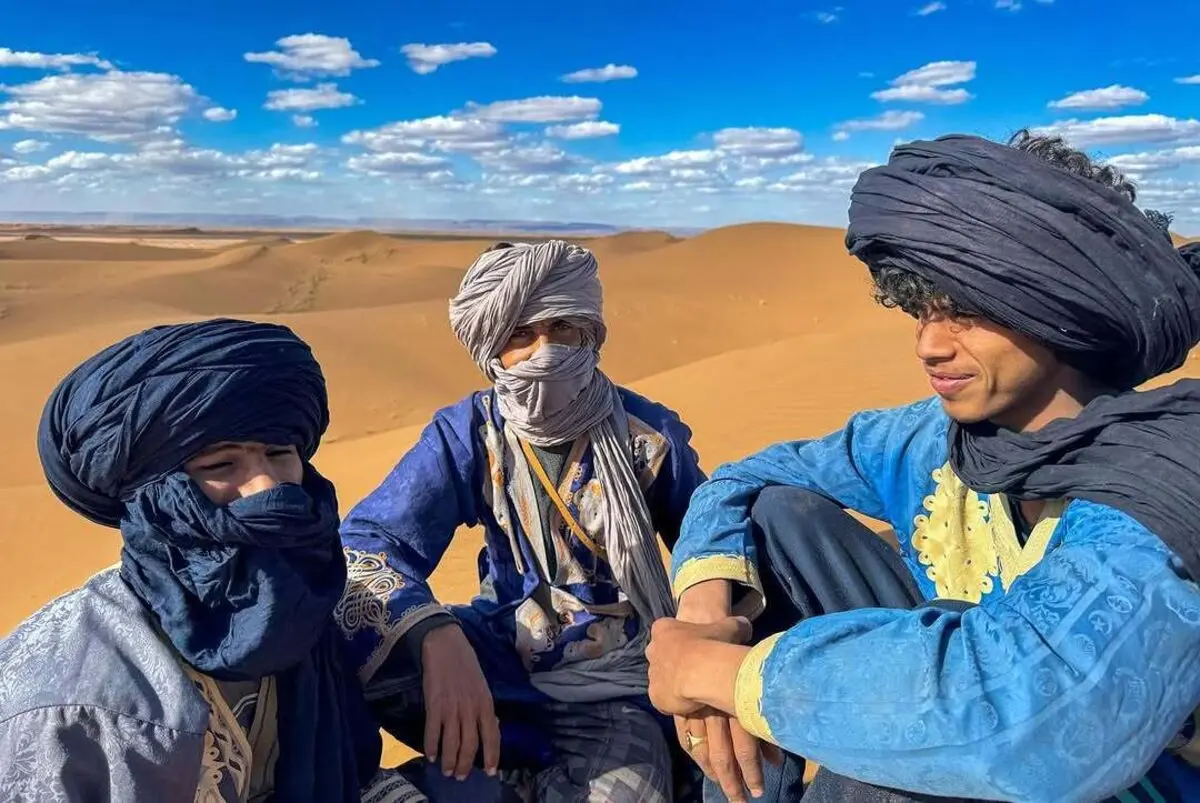
🐪 Slow down and experience M’Hamid with our travel guide and treks. travel-guide.html → · short-treks.html →